

Caustic Soda Flakes vs Pearls vs Lye: Grades, Purity and Which to Buy
Every form of caustic soda is the same chemical: sodium hydroxide, NaOH (CAS 1310-73-2). What changes is how much water has been removed and the shape the solid is cast into. That decides how it is packed, how far it can travel economically, how it is dosed, and what you pay per kilogram of actual NaOH.
Flakes, pearls and lye at a glance
| Form | NaOH content | Looks like | Usual supply | Indian HSN | Best for |
|---|---|---|---|---|---|
| Flakes | 98–99% | White, brittle flakes | 25 kg and 50 kg bags | 28151110 | Most users who buy in bags and dissolve on site |
| Pearls (prills) | About 99% | Small, free-flowing white beads | Bags | Under 2815.11 (solid) | Automatic dosing, small batches, less dust |
| Lye (liquid) | 32% or 46–50% solution | Clear, colourless liquid | Road tankers | 28151200 | Large, continuous users with storage tanks |
Same chemical, different form
Caustic soda is made in chlor-alkali plants by passing electricity through brine. The cells produce caustic soda as a solution of roughly 32% NaOH. Producers concentrate part of it to about 48–50% lye, and evaporate the rest completely to make solid caustic soda, which is either cast into flakes or sprayed into pearls.
So when you buy flakes or pearls, you are paying for the water to be taken out; when you buy lye, you are paying to transport the water. Neither is “stronger” once it is in your process — 1 kg of NaOH reacts the same way whichever form it arrived in.
Flakes vs pearls
Flakes and pearls have practically the same purity. The differences are physical:
- Flow and dosing: pearls are round and pour like sand, which makes them easier to meter through screw feeders and automatic dosing systems. Flakes can bridge in hoppers.
- Dust: pearls produce less dust when bags are emptied. With flakes, careful handling and PPE matter more.
- Dissolving: both dissolve completely; pearls dissolve a little more evenly because the particle size is uniform.
- Availability: flakes are the most widely traded solid form in India and are what most plants in Gujarat buy in bags.
If you dissolve caustic soda in a tank to make your own solution — as most textile processors, effluent plants and chemical units do — flakes do the job and are the usual choice.
Solid or lye: what you are really paying to transport
Lye is cheaper to produce than flakes because the producer skips the evaporation step. But 48% lye is more than half water, so freight, handling and storage are paid on nearly twice the weight. This table shows how much lye carries the same NaOH as one tonne of 98% flakes:
| To replace | You need | Extra weight moved |
|---|---|---|
| 1 tonne of 98% flakes | About 2.04 tonnes of 48% lye | About 1.04 tonnes of water |
| 1 tonne of 98% flakes | About 3.06 tonnes of 32% lye | About 2.06 tonnes of water |
That is why lye usually makes sense only for plants that use caustic soda continuously, have a storage tank and pumps, and are close to a producer — for example in the Bharuch–Dahej belt. Lye also needs some care in storage: 50% lye starts to crystallise at around 12 °C, so tanks in colder places are often heated.
Solid caustic soda is the better fit when you buy smaller or irregular volumes, need to move material a long way, export it, or simply do not want to run a tank farm. Bags can be stored on a pallet and opened only when needed.
98% or 99%? Grades and what to check on the COA
Industrial caustic soda flakes are sold at 98–99% NaOH. For most uses — textile scouring and mercerising, soap making, effluent neutralisation, metal cleaning, chemical reactions — both are suitable. What matters more is that the lot meets your process limits. A Certificate of Analysis (COA) for caustic soda usually reports:
- NaOH content — the active alkali you are paying for.
- Sodium carbonate (Na₂CO₃) — forms when caustic soda absorbs carbon dioxide from air; high values point to old or badly stored material.
- Sodium chloride (NaCl) — left over from the brine.
- Iron — important for viscose, pharma and bleaching processes, where higher-purity grades are specified.
Tell your supplier what the caustic soda is for. If your process has tight limits on salt or iron, ask for the COA before dispatch and compare it with your specification.
Handling and storage for every form
- Corrosive: solid caustic soda is UN1823 and lye is UN1824, both Class 8. Wear goggles or a face shield, gloves and protective clothing.
- Always add caustic soda to water, slowly, never water to caustic soda. Dissolving releases a lot of heat and can boil and spatter.
- Keep bags sealed and dry. NaOH pulls in moisture and carbon dioxide from the air, which makes flakes lump and slowly turns some of it into sodium carbonate. Use older stock first.
- Keep away from aluminium, zinc and acids. Caustic soda attacks aluminium and zinc and gives off hydrogen; with acids it reacts violently.
Which form should you buy?
- Buy flakes if you dissolve caustic soda on site, buy by the bag or the truckload, or your consumption varies month to month.
- Consider pearls if you dose solid caustic soda automatically or need very low dust.
- Consider lye if you use large, steady volumes, have a storage tank and pumps, and are close to a producer.
- Exporting? Solid caustic soda in bags is the standard choice for container shipments.
We supply caustic soda flakes from GACL, Grasim, DCM Shriram and Epigral in 25 kg and 50 kg bags from our Ankleshwar warehouse, and caustic soda lye on request. For makes, packing and delivery times across Gujarat, read our guide to buying caustic soda flakes in Gujarat.
GACL, Grasim, DCM Shriram and Epigral are trademarks of their respective owners. Aethon Chemicals is an independent supplier and stockist of genuine material and is not affiliated with these manufacturers.
Products in this guide
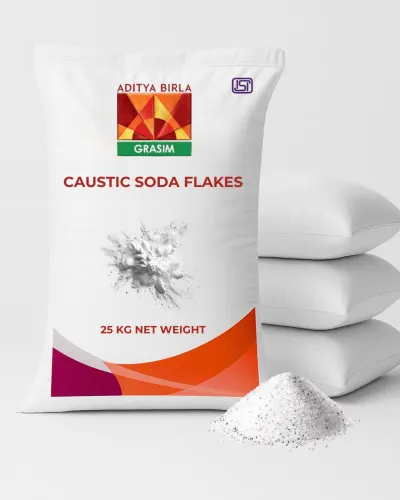
Caustic Soda Flakes
Sodium Hydroxide
Caustic Soda Flakes (Sodium Hydroxide)Chemical Name: Sodium Hydroxide Chemical Formula: (NaOH)Form: White, free-flowing flakesPurity & Grade: 98% – 99% (Industrial Grade)CAS No.: 1
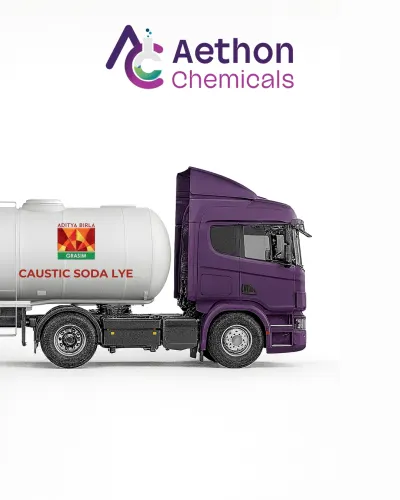
Caustic Soda Lye
Sodium Hydroxide
Caustic Soda Lye (Liquid Sodium Hydroxide)Chemical Name: Sodium HydroxideChemical Formula: (NaOH)Form: Clear to slightly hazy liquidPurity & Grade: 47% – 49% (Industrial Grade)CAS
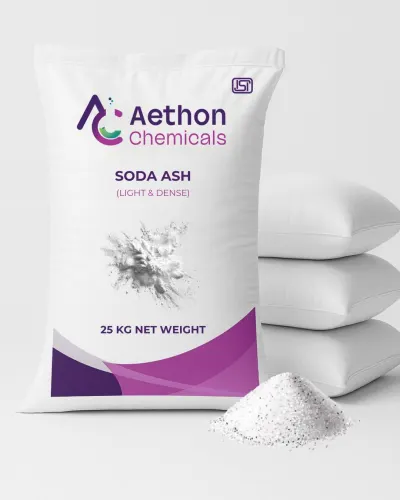
Soda Ash (Light & Dense)
Sodium Carbonate
Soda Ash (Light & Dense)Chemical Name: Sodium CarbonateChemical Formula: Na₂CO₃Form: Powder / Granules (Light & Dense)Grade: Industrial / Technical GradeCAS No.: 497-19-8HSN Code:
Frequently Asked Questions
Need a quote?
Tell us the product, quantity, packing and delivery location — we reply with pricing and availability within 24 hours.
More Market Insights
Soda Ash Light vs Dense: Differences, Uses and Which to Choose
Light and dense soda ash are the same chemical — sodium carbonate, about 99% Na₂CO₃ — and differ only in particle size and bulk density. Dense soda ash (granular, about 0.9–1.1 tonnes per cubic metre…
Read the guide →Buying Caustic Soda Flakes in Gujarat: Makes, Packing, Delivery and Price Factors
Most buyers in Gujarat choose between four Indian makes of caustic soda flakes — GACL, Grasim, DCM Shriram and Epigral — at 98–99% NaOH in 25 kg or 50 kg bags. From our Ankleshwar warehouse we delive…
Read the guide →