

Soda Ash Light vs Dense: Differences, Uses and Which to Choose
Soda ash is sodium carbonate, Na₂CO₃ (CAS 497-19-8). Buyers order it as “light” or “dense”, and it is easy to assume one is purer or stronger than the other. It isn't: both are about 99% sodium carbonate. The difference is physical — the size of the particles and how much a bag weighs for its volume — and that decides which industries use which.
Light vs dense soda ash at a glance
| Property | Soda ash light | Soda ash dense |
|---|---|---|
| Chemical | Sodium carbonate, about 99% Na₂CO₃ | Sodium carbonate, about 99% Na₂CO₃ |
| Appearance | Fine white powder | White granules |
| Bulk density | About 0.5–0.6 t/m³ | About 0.9–1.1 t/m³ |
| Dust | Dusty when handled | Low dust |
| Dissolving | Fast | Slower, but complete |
| Indian HSN | 28362020 | 28362010 |
| Main users | Detergents, sodium silicate and other chemicals, textiles, water treatment | Glass (float, container, specialty), some detergents and metallurgy |
How the two grades are made
In the synthetic (Solvay) process, sodium bicarbonate is heated to drive off water and carbon dioxide. What comes out is light soda ash: a fine, porous powder. To make dense soda ash, light soda ash is converted to sodium carbonate monohydrate crystals and heated again, giving larger, heavier granules. The chemistry of the finished product is the same; the second step only changes the grain.
Why glass makers use dense soda ash
Soda ash is the main alkali in glass, mixed with sand, limestone and other raw materials before melting. Glass plants specify dense because:
- The batch stays mixed. Dense granules are close in size to sand, so they don't separate out on conveyors and in silos the way a fine powder does.
- Less dust goes into the furnace. Fine powder is carried off by furnace gases and damages regenerators; granules are not.
- Less material is lost in handling, so the batch recipe stays accurate.
Why detergents, chemicals and textiles use light soda ash
- Detergent powders: light soda ash is a builder and alkali that mixes evenly with other powders.
- Chemical manufacturing: making sodium silicate, sodium bicarbonate and other sodium salts, where fast dissolving speeds up the reaction.
- Textile dyeing: fixing reactive dyes and scouring — the soda ash is dissolved in the dye bath.
- Water treatment: softening water and raising pH.
Where soda ash is completely dissolved before use — as in dye baths and water treatment — either grade works chemically. Choose on handling: light dissolves faster; dense is cleaner to handle and takes less space.
Same weight, different volume: bags, trucks and storage
Because light soda ash weighs roughly half as much per cubic metre, a 50 kg bag of light is noticeably bigger than a 50 kg bag of dense. A truck or container of light soda ash can fill its space before it reaches its weight limit, and light takes more warehouse room per tonne. Both grades should be stored dry: soda ash absorbs moisture and forms lumps. Soda ash is not classified as dangerous goods for transport, but the dust irritates eyes, so goggles and a dust mask are sensible when emptying bags.
Makes we stock
We supply soda ash light and dense in 25 kg and 50 kg bags from:
- Tata Chemicals — Tata Chemicals Limited
- Nirma — Nirma Limited
- GHCL — GHCL Limited
- Imported soda ash — origin confirmed for each lot
All three Indian makes produce soda ash on Gujarat's Saurashtra coast, close to the salt and limestone the process needs.
Which one should you order?
| Your use | Order |
|---|---|
| Float, container or specialty glass | Dense |
| Detergent powders | Light (dense where your plant is set up for it) |
| Sodium silicate, bicarbonate and other sodium salts | Light |
| Textile dyeing and scouring | Light |
| Water softening and pH control | Light or dense |
| Ceramic glazes and frits | As your recipe specifies |
Delivery and export
From our Ankleshwar warehouse, soda ash reaches Ankleshwar and Panoli the same day; Bharuch, Dahej, Surat, Sachin and Vadodara the same or next day; Navsari, Vapi and Ahmedabad in 1–2 days; and Morbi and Rajkot in 2–3 days. We also export soda ash to Bangladesh, Vietnam, Indonesia, Sri Lanka and the UAE.
Not sure whether you need soda ash or caustic soda? Soda ash is a milder alkali; caustic soda (sodium hydroxide) is far stronger and corrosive — see our caustic soda guide.
Tata Chemicals, Nirma and GHCL are trademarks of their respective owners. Aethon Chemicals is an independent supplier and stockist of genuine material and is not affiliated with these manufacturers.
Products in this guide
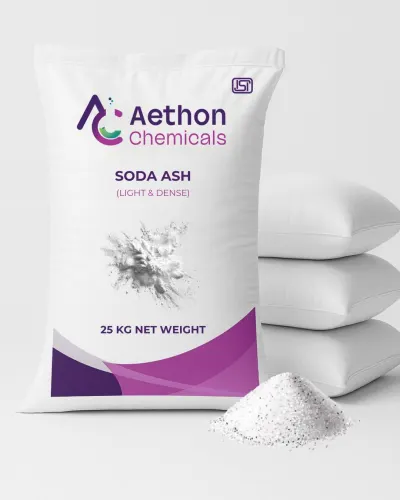
Soda Ash (Light & Dense)
Sodium Carbonate
Soda Ash (Light & Dense)Chemical Name: Sodium CarbonateChemical Formula: Na₂CO₃Form: Powder / Granules (Light & Dense)Grade: Industrial / Technical GradeCAS No.: 497-19-8HSN Code:
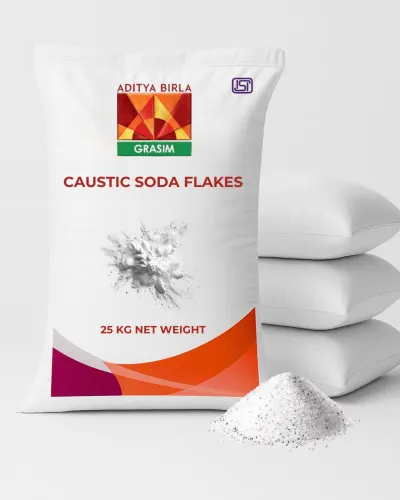
Caustic Soda Flakes
Sodium Hydroxide
Caustic Soda Flakes (Sodium Hydroxide)Chemical Name: Sodium Hydroxide Chemical Formula: (NaOH)Form: White, free-flowing flakesPurity & Grade: 98% – 99% (Industrial Grade)CAS No.: 1
Frequently Asked Questions
Need a quote?
Tell us the product, quantity, packing and delivery location — we reply with pricing and availability within 24 hours.
More Market Insights
Caustic Soda Flakes vs Pearls vs Lye: Grades, Purity and Which to Buy
Flakes, pearls and lye are all sodium hydroxide (NaOH). Flakes and pearls are solid, about 98–99% NaOH, and suit buyers who use bags, buy varying volumes or move material over long distances; lye is …
Read the guide →Buying Caustic Soda Flakes in Gujarat: Makes, Packing, Delivery and Price Factors
Most buyers in Gujarat choose between four Indian makes of caustic soda flakes — GACL, Grasim, DCM Shriram and Epigral — at 98–99% NaOH in 25 kg or 50 kg bags. From our Ankleshwar warehouse we delive…
Read the guide →